Summary
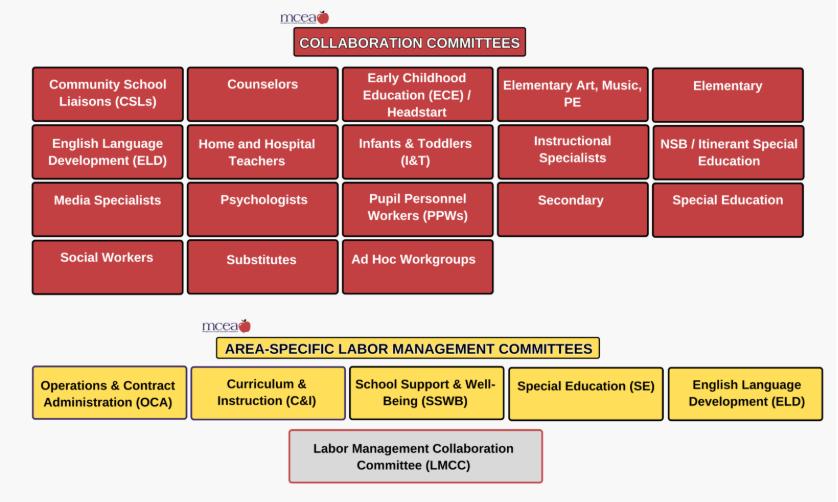
MCEA Labor Management Committees (LMCs), Collaboration Committees (CCs), and Ad Hoc contractual workgroups meet jointly with MCPS representatives to engage in collaborative problem solving on matters related to curriculum, instruction, student services, and educator working conditions. Committees provide a structured space for educators to raise concerns, share insights, and influence decisions that affect their work and students.
To share feedback with a committee, please complete the relevant form below. Feedback forms will remain accessible to MCEA unit members throughout the academic year. For questions, please reach out to your assigned UniServ Director.
Committee Feedback Forms
- Community School Liaisons CC Feedback Form
- Counselors CC Feedback Form
- Early Childhood Education / Headstart CC Feedback Form
- Elementary Art, Music & PE CC Feedback Form
- Elementary CC Feedback Form
- English Language Development CC Feedback Form
- Infants & Toddlers CC Feedback Form
- Instructional Specialists CC Feedback Form
- Non-School Based / Itinerant Special Educators CC Feedback Form
- Media Specialists CC Feedback Form
- Psychologists CC Feedback Form
- Pupil Personnel Workers CC Feedback Form
- Secondary CC Feedback Form
- Social Workers CC Feedback Form
- Special Education CC Feedback Form
- Technology Workgroup Feedback Form
- Material & Supply Selection Workgroup Feedback Form
 Committee Decision Making
CBA Language
Article 6 F.
Labor-Management Collaboration Committee
- The system-level Labor Management Collaboration Committee (LMCC) shall meet regularly to discuss and make decisions on matters germane to union-management relations and, when appropriate, to the continuous improvement of instruction and school system operations. Each party shall identify four to six representatives, as permanent members of the committee. Members of relevant subcommittees will be invited to attend LMCC meetings when appropriate.
- The overall charge to the systemwide LMCC shall include but not be limited to the following:
-
- a. Interpreting and administering the implementation of the negotiated Agreement
- b. Addressing Blueprint for Maryland’s Future implementation matters that impact existing collective bargaining language, and, more generally, working conditions not specified in the Agreement
- c. Discussing any matters of mutual interest or concern and reaching tentative agreements on issues in a timely manner
- d. Reviewing and assessing the effectiveness of collaboration between MCPS and MCEA
- e. Delegating to the appropriate area-specific labor management committee and/or collaborative body any matter of mutual concern to:
- 1) Collect constituent feedback
- 2) Make a report and recommendation to the LMCC that shall be adopted, rejected, or modified by the LMCC or remanded to the appropriate committee or body for further review.
- f. Reviewing and assessing the effectiveness of all state and system-mandated assessments.
- 1) Based on the More Learning, Less Testing Act which became effective June 1, 2017, and upon ratification of the agreement, the LMCC shall begin creating a time impact statement for all assessments currently in use. The scope of school years to be included shall be determined by the LMCC.
- 2) The LMCC shall annually track and evaluate these real-time impacts and report the hours devoted to all aspects of mandated assessment administration to the staff from a representative, random sample of classrooms.
- 3) The Board and the Association agree to work together to reduce the amount of time diverted away from instruction.
a. Area-Specific Labor Management Committee
- Under the auspices of the MCEA Labor Management Collaboration Committee, area-specific labor management committees shall meet on a monthly basis to develop and review regulations and practices related to their area of focus and be proactive in resolving issues of concern. These committees will include but are not limited to:
i. Special Education Labor Management Committee
ii. School Support and Well-Being Labor Management Committee
iii. Operations & Contract Administration Labor Management Committee
iv. English Language Development Labor Management Committee
2. Area-specific labor management committees will make recommendations to the LMCC after reviewing the issue and seeking input.
Article 6 F. 5. a. 6.
Non-School Based Collaboration Committees are charged with holding ongoing discussions and engaging in collaborative problem-solving on matters of interest and concern. Each collaboration committee is expected to be representative of and accountable to staff and involve staff in the decision-making process. These committees shall include but are not limited to:
- English Language Development
- Montgomery County Infant and Toddlers Program
- Pupil Personnel Workers
- School Psychologists
- Instructional Specialists
- Non-School Based/Itinerant Special Educators
- The appropriate supervisor and the MCEA representative will work together to arrange a reasonable amount of time for the staff to select the members of the collaboration committee.
iii. Workgroups may be used as an attempt to collaboratively resolve issues informally at the lowest level. Workgroups shall include but are not limited to:
- Material & Supply Selection
- Technology
Article 6 F. 5. b. 1.
The School-Based Collaboration Committees provide school-based unit members with an opportunity to discuss, collaborate with MCPS staff, and communicate about MCPS initiatives related to their areas of practice, including:
i. Early Childhood Education/Headstart
ii. Elementary
iii. Secondary
iv. Elementary Art, Music, P.E.
v. Media Specialists
vi. Counselors
vii. CSLs
viii. Social Workers
ix. Special Education
- They shall participate with MCPS representatives in collaborative problem-solving regarding matters germane to their areas of practice. MCPS representatives shall be available for scheduled meetings with collaboration committee representatives.
- They will communicate regularly with their constituency groups for feedback, input, and suggestions.
- Any new systemwide assessments will be presented to and discussed with the relevant collaboration committee prior to any final decision on implementation.
- Where appropriate, collaboration committees will make recommendations to the LMCC after reviewing the issue and seeking input.